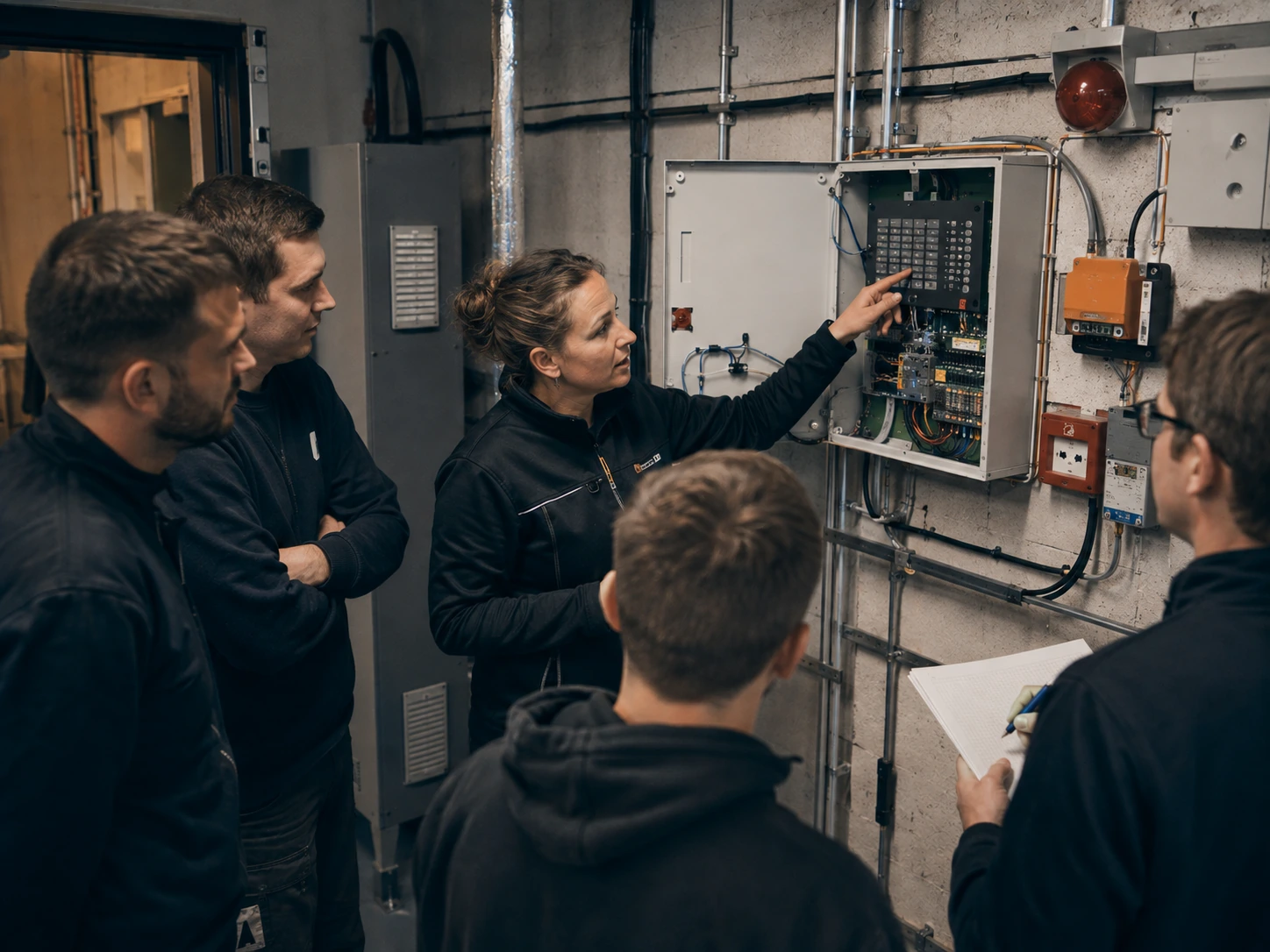
What the training is about.
Fire safety officers coordinate tasks, follow up on measures within the company and create the link between organisation, technology and responsible persons. The detail page shows the planned content structure; binding content follows the approved course announcement.
Who the course is intended for.
- People who must be appointed as fire safety officers under an official decision, law or insurance contract
- People who are to take on fire protection tasks within the company
- Responsible persons from facility management, technical services and organisation
- Current post holders who want to refresh their knowledge in a structured way
Structure of the training.
According to TRVB 117 O, fire safety officer (BSB) training consists of module 1 and module 2. Module 1 is also the basic training for fire wardens. All training paths at a glance can be found on the page Fire safety training.
- Module 1 – basics: 360 minutes of training with final assessment, including practical exercises with fire extinguishers
- Module 2 – fire safety officer: 660 minutes of training with written final assessment
- Modules 1 and 2 together: at least three training days
- Afterwards: technical and use-related seminars matching the business and its existing systems
What module 2 covers.
- Legal basis, Workplace Ordinance (AStV), trade and provincial regulations
- Structural fire protection: escape and rescue routes, fire compartments, firestops and fire-rated closures
- Technical fire protection: fire alarm, extinguishing, smoke and heat extraction systems
- Tasks of the fire safety officer and setting up the fire safety organisation
- Fire safety regulations, fire safety log, self-checks and defect documentation
- Fire alarm and evacuation drills, preparing for fire brigade operations
- Failures and shutdowns of fire protection equipment and substitute measures
Completion and fire safety pass.
After passing the final assessment, you receive a certificate and the training is entered in your fire safety pass. After modules 1 and 2, you can provisionally take on the tasks of a fire safety officer. The appropriate technical and use-related seminars must be completed within the deadlines of TRVB 117 O.
Further training every five years.
Further training must be attended no later than five years after the last creditable event. It lasts at least 360 minutes; alternatively, jours fixes of at least 120 minutes each can be accumulated within this period. Details can be found under Further training and fire safety pass.
 German
 English